

General Admission: A full-circle moment
'I think the people that I've surrounded myself with, my friends in college, my friends on my course. I think being able to make so many different friends from different backgrounds has really shaped who I am now.'
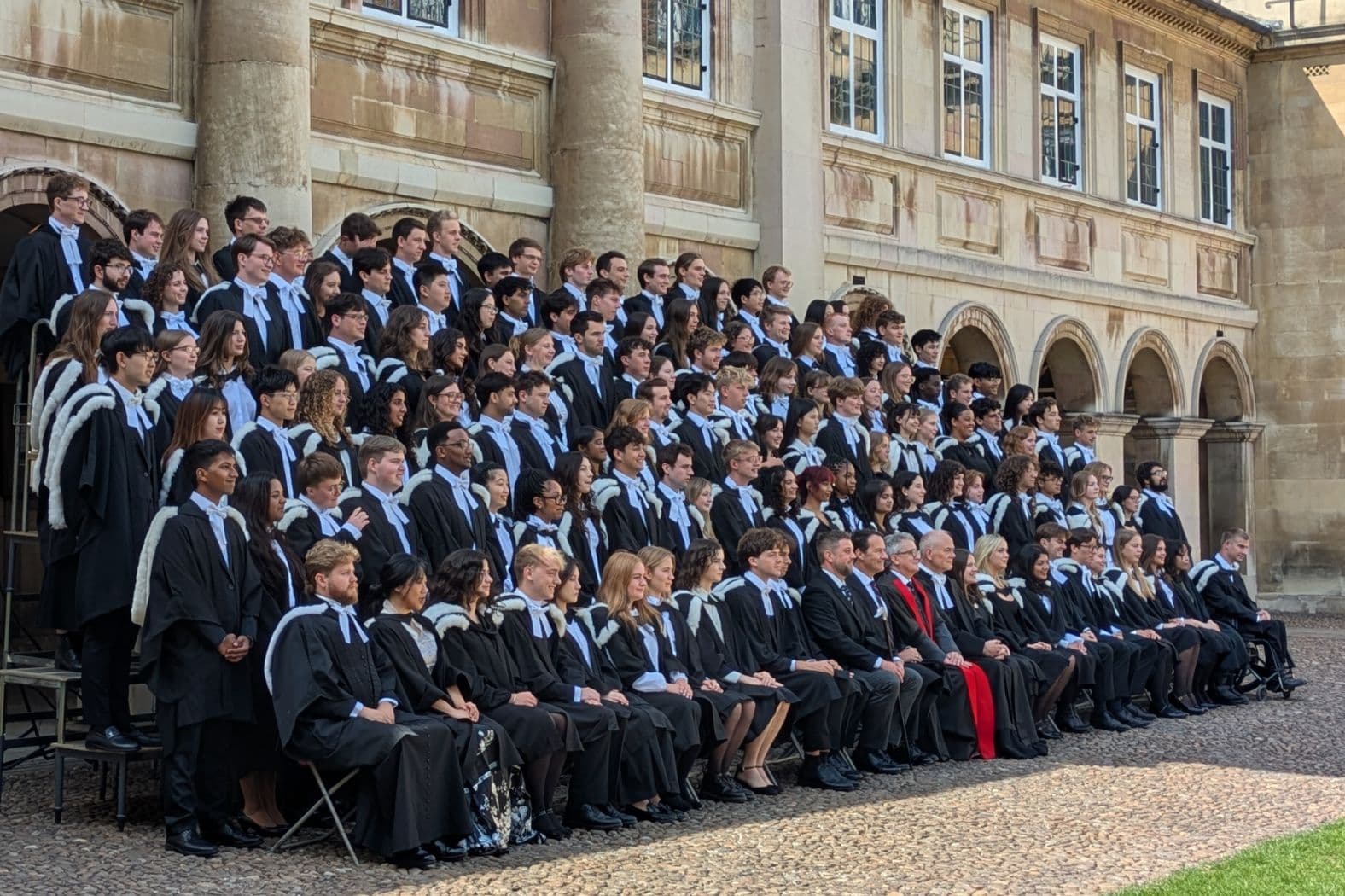
General Admission, or graduation, marks both an ending and a beginning. Pride, excitement and nostalgia sit alongside nervous anticipation as students celebrate years of study, personal growth and friendship, and begin to consider what comes next.
Speaking to Emmanuel graduates who went to the Senate House in June, a clear theme emerged: graduation is about much more than receiving a degree. It marks how far they have come since arriving as apprehensive new students, while bringing new questions about what comes next. For some, the future feels full of possibility; for others, not knowing which path to take can make this a time of uncertainty.
For many, the day brought a mixture of emotions.
‘I’m really grateful for it,' said Rhiannon, who studied Anglo-Saxon, Norse and Celtic (ASNaC). ‘Today has been a bit overwhelming, exciting, a lot of nerves, but I’m really excited to celebrate with my parents and my friends later.
‘There’s a lot of similar emotions on your matriculation and graduation days, but it’s a nice sort of circular feeling to get here.’
The idea of graduation as a ‘full circle’ moment resonated strongly with many students. Connor, who completed a degree in Psychology as part of his medical studies, described graduation as both joyful and emotional.
‘It brings back a lot of memories,’ he said. ‘It’s quite emotional knowing there are lots of people here that we won’t see for quite a long time, but seeing everyone together makes us all very, very happy.’
Growing in confidence
For some graduates, the most striking realisation was just how much they had changed. When students first arrive at university, many are stepping into an unfamiliar environment, often for the first time. By graduation, they leave with a new sense of confidence and independence.
Fourth-year graduate, Hussein, who studied Japanese through Asian and Middle Eastern Studies, said that one of the biggest transformations had been in his ability to connect with others.
‘Prior to coming to Cambridge, I was a bit more introverted,' he said. ‘After Emmanuel, I love being more extroverted, talking to new people and creating new memories.’
Alongside personal growth, Hussein pointed to another achievement: arriving with no Japanese and leaving four years later speaking the language with confidence.
Others spoke about gaining maturity in ways they never expected. Lorna, also an ASNaC graduate, reflected on the remarkable changes she had experienced.
‘I feel like when I came up to Emma I was a baby,' she said. ‘Now I’m coming out the other side and I’m a woman. I’ve become surer in myself, more eager to defend my principles and my morals. The confidence in me has just grown amazingly.’
Friendships that last
While degrees and academic achievements were important, almost every graduate identified one factor as having the greatest impact on their university experience: the people. Students returned repeatedly to the friendships they had built and the communities they had found.
For Rhiannon, it was ‘being able to make so many different friends from different backgrounds’ that shaped who she is today.
Ben, who studied Astrophysics as part of a Natural Sciences degree, highlighted the value of the friendships that supported him throughout his studies.
‘I’ve had some really good friendships here that have carried me through all three years,' he said. 'The support system here is great.’
Many students admitted they had arrived with stereotypes about Cambridge, expecting an intensely competitive or intimidating environment. Instead, they found a welcoming and supportive community.
‘I was expecting people to be quite stuffy or maybe uptight,' said Astrid, who studied Human, Social and Political Sciences (HSPS). 'Emma has been so friendly and everybody’s been so wonderful.’
Connor shared this view. ‘There’s a stereotype that it’s brutally competitive at Cambridge, but it’s not. Everyone is so lovely.’
Finding a home at Emma
Graduates also reflected on the places that became part of their daily lives and memories. Favourite locations ranged from the swimming pool and the paddock to the dining hall, chapel and their accommodation.
For Rhiannon, the hall stood out because of the memories created there through meals, formals and celebrations. For Astrid, the paddock’s green space provided a peaceful retreat. Anthony, a Natural Sciences graduate, chose the recently renovated college bar, describing it as a place for community, music and connection.
When asked what advice they would give to incoming students, the guidance was clear:
‘Get stuck in.’
‘Say yes to things.’
‘Put yourself out there.’
Whether through clubs, sports, theatre, music, rowing, student representation, fashion shows or academic societies, graduates encouraged new students to embrace opportunities and try activities beyond their comfort zones.
‘Meet as many people as possible,' said Ben. ‘Join as many societies as you can and try a sport that you haven’t done before.’
Olga, who studied History, advised students to spend at least their first year saying yes to as many opportunities as they can. ‘It’s a very special place,’ she said. ‘Just make sure you’re making the most of it.’
Looking ahead
As this year’s graduates celebrate, attention is already turning towards the future. For some, that future involves further study. Astrid will remain at Emmanuel to undertake an MPhil, while Connor continues his journey towards becoming a doctor.
Others are preparing for careers around the world. Hussein hopes to return to Japan, while Olga plans to study Russian in Armenia before exploring future opportunities. Lorna is embarking on a law conversion course with the ambition of becoming a barrister, focusing on protecting women and girls from domestic violence.
The paths ahead are varied, and the graduates’ optimism is tempered by an awareness of the challenges they may face.
Those graduating today are entering a challenging job market, shaped by competitive recruitment and a rapidly changing world of work. Some leave with firm plans, while others are still deciding what they want to do. Their time at Emmanuel has nevertheless helped them develop skills, resilience and adaptability that should stand them in good stead to navigate the opportunities and obstacles ahead.