

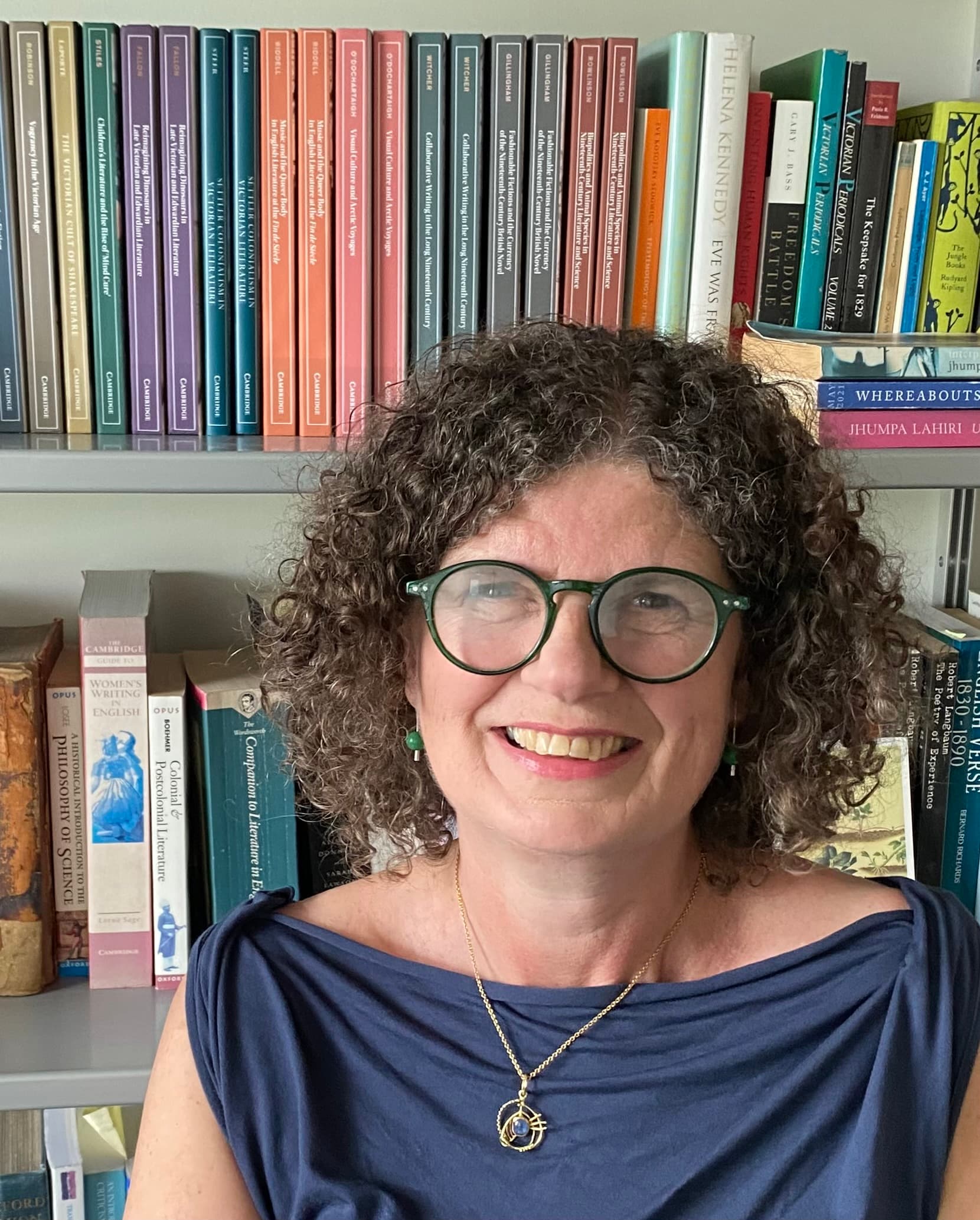
Professor Clare Pettitt
BA, MSt (Cantab.), DPhil (Oxon.)
Clare has been an Official Fellow since 2023. She is a Teaching Fellow in English, and the Grace 2 Professor of English at the University.
Biography
Clare grew up in Manchester and studied at Emmanuel as an undergraduate. She moved to London to work in journalism and theatre, followed by a DPhil in Oxford. She was based at Linacre College, transferring to Pembroke College (Oxford), when she was awarded the Robert Browning Research Studentship. After completing her PhD, she moved to Leeds University, and in 1998 returned to Cambridge as a College Teaching Officer and Director of Studies in English at Newnham. Leaving Cambridge once more, Clare moved to a lectureship at King’s College, London in 2005, and was promoted to Professor in 2008. In 2016 she was seconded for two years to Director of the London Arts and Humanities Partnership (LAHP), and returned to Emmanuel in 2023. During her academic career, she has been a Visting Scholar in New York, California, Sweden, Berlin and Florence.
Research
Clare's research is broadly on nineteenth-century literature and culture, across British, European and American contexts. In the first two books, she investigated concepts of authorship and mechanical invention in the nineteenth century and Anglo-American relations through an iconic meeting between two explorers in Africa. She is currently investigating the intertwined international histories of literature and art; digital coding; and investigations into genetic and racial coding starting in the 1850s and 1860s.
Over the last 5 years, she has been writing a trilogy of academic publications on the importance of seriality in the nineteenth century. The first book Serial Forms: The Unfinished Project of Modernity, 1815-1848 (OUP, 2020) won three international book awards. The second volume Serial Revolutions 1848: Writing, Politics, Form (OUP, 2022) focuses on 1848 and its series of revolutions as a pivotal and important moment in European and American culture and politics. The third volume will argue that the series and serial transmission became increasingly dominant methods for formatting and communicating information across ever longer distances from the mid-century onwards.
BA, MSt (Cantab.), DPhil (Oxon.)